Skip to McMaster Navigation Skip to Site Navigation Skip to main content
mcmaster university logo McMaster logo

ChemLab Day (New for April 2026)

Beginning in April 2026, we are launching an exciting new outreach program for Grade 11 and 12 studentsLight, Matter & Chemistry, an immersive, hands-on lab and campus experience inspired by university-level spectroscopy and analytical techniques used in chemistry research. 

Students will work with flame emission, spectrophotometers, fluorescence, and chromatography to explore how matter interacts with light and how chemists analyze the world at the atomic and molecular scale.

ChemLab Day Overview:

ChemLab Days are designed for high school students interested in the study of chemistry, chemical biology, and sustainable chemistry. Led by faculty, graduate and undergraduate chemical science outreach ambassadors in our department, tours usually last 150 minutes and include:

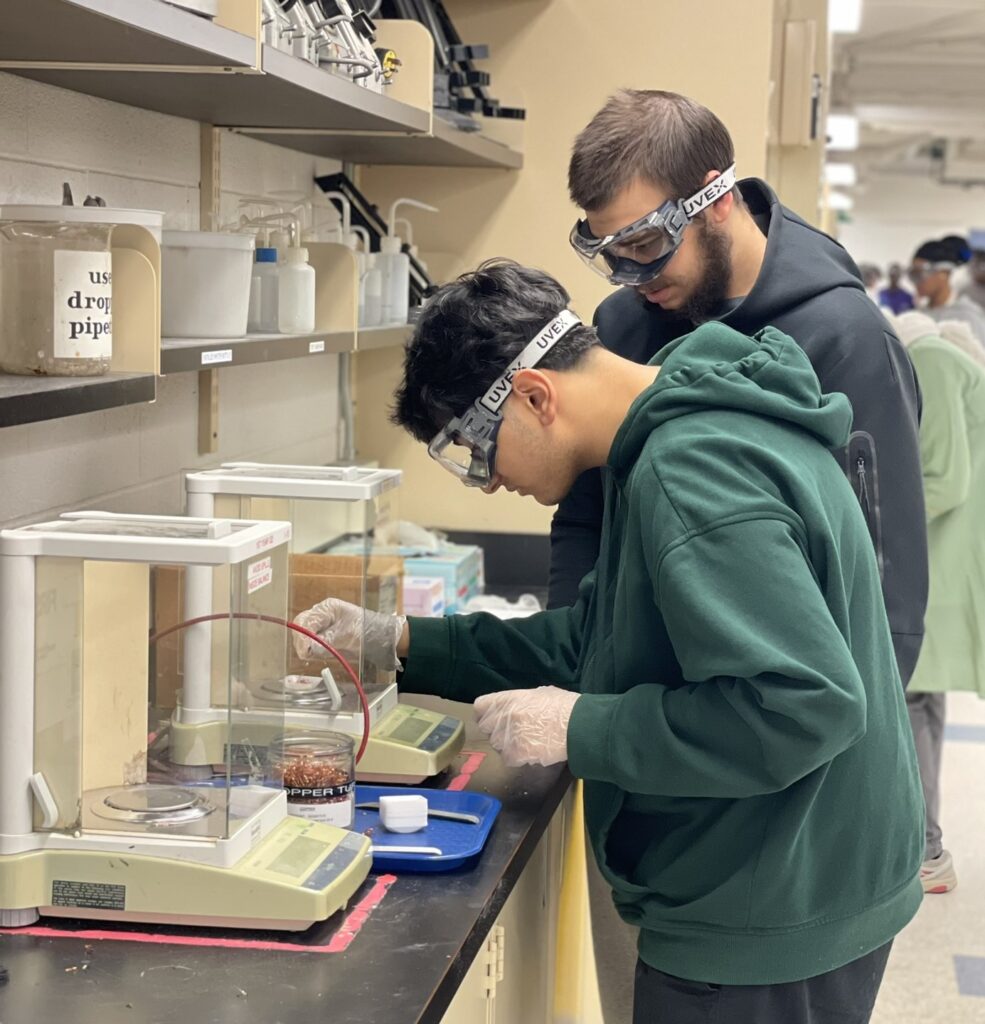
two students weighing copper

1. A 90-minute “hands on” Light, Matter and Chemistry laboratory experience;

2. A 60-minute interactive guided carousel tour of 5 Core Research Facilities (MS, NMR, Light Microscopy, Electron Microscopy and X-Ray Diffraction);

3. Optional 60-minute campus tour by Faculty of Science tour guides;

4. Optional 60-minute lunch or campus time


We are currently welcoming:

  • Grade 11 and 12 chemistry classes up to 60 students per lab session
  • Larger groups (> 60 students) will require a longer visit to rotate all students through the activities

Experiment and Tour Component Descriptions:

Students rotate through five interactive experimental stations, each exploring a different technique used in chemical analysis: 

Station 1 — Flame Tests: Atomic Emission 

Students observe characteristic emission colours of different metal salts to learn how electron transitions produce visible light. Spectrographic glasses will allow students to observe the wavelengths of light that comprise the light observed from a flame test. 

Themes: emission spectra, quantized energy levels, atomic structure and theory. 

Station 2 — Absorption Spectrophotometry and Concentration 

Using a spectrophotometer, students will how concentrated and dilute coloured solutions differ in their absorption of light at a specific wavelength. 

Themes: absorption, concentration dependence, quantitative analysis. 

Station 3 — UV Fluorescence Induced FluorescenceInduced Fluorescence 

Students will use UV flashlights to reveal fluorescence in solutions of commonly found substances in the home. 

Themes: molecular excitation, fluorescence vs. atomic emission. 

Station 4 — Determining Atomic Radius 

Students will calculate the approximate radius of a series of metal atoms using mass, volume and density measurements,  Avogadro’s number, and packing structure. 

Themes: density, molar mass, unit cell packing, atomic radius 

Station 5 — Candy Chromatography 

Students separate dye mixtures from a popular brand of candy to explore chromatographic separation.

Themes: polarity, mobile vs. stationary phases, analytical separations 

Split into groups of up to 12 participants, students will be guiding by our Chemical Science Outreach Ambassadors to visit several of McMaster’s worldclass scientific facilities*, such as the:

  • McMaster Regional Centre for Mass Spectrometry (MRCMS)
  • McMaster Analytical XRay Diffraction Facility (MAX)
  • Nuclear Magnetic Resonance Facility (NMR)
  • McMaster Centre for Advanced Light Microscopy (CALM)
  • Canadian Centre for Electron Microscopy (CCEM)

At each stop, students learn how different instruments are used to characterize matter in real-time Highlights of the carousel include: seeing the surface structure of a student’s fingernail using optical microscopy, viewing scanning tunnelling electron microscopy images of an array of metal atoms, real-time auto-sampling of an NMR sample, and more.

*Facility availability may vary.

(Optional) Led by undergraduate student Science Ambassadors, the Faculty of Science provides high school and prospective students with a tour of the labs, facilities and services used by students in Level I Science programs. Tours are 60 minutes in length.

(Optional) A 60-minute free time for students to eat, explore campus, or visit the McMaster University Student Centre. Strongly recommended for groups with multiple classes, over 60 students, or groups who will be joining us for more than 3 hours.

students walking on campus

Available Offerings:

ChemLab Day will be offered annually beginning April 2026. Booking will open in February for April dates on a first come, first served basis for morning (9 am – 12 pm) and afternoon (12 pm – 3 pm) slots for the Laboratory Experience and Core Facilities Carousel Tours. We will work with schools who also wish to book Lunch and Campus Tours to schedule these activities within your arrival and departure windows.

Please refer to the table below for available time slots. We will keep this updated to reflect current availability.

Date Morning slot
(9AM-12PM)
Afternoon slot
(12PM-3PM)
Mon Apr 20, 2026 Fully booked Fully booked
Tue Apr 21, 2026 Fully booked Fully booked
Wed Apr 22, 2026 Fully booked Fully booked
Thu Apr 23, 2026 Fully booked Fully booked
Fri Apr 24, 2026 Fully booked Fully booked

Booking Your Visit:

To book a visit, please fill out the ChemLab Day at McMaster Booking Form to indicate your interest in joining us. Please select all dates and times when you are available to attend.

We will be in touch to confirm your date and time. Kindly allow up to 72 business hours for a response. Please contact Tanja Petrovic if you do not receive a response.
When booking, teachers will be asked to provide:

  • Contact details
  • School name and location
  • Grade level and number of students
  • Preferred dates
  • Earliest arrival & latest departure times
  • Accessibility requirements
  • Whether you would like a Faculty of Science tour or lunch break added

If there are no available slots, schools may place themselves on the waitlist for future offerings where priority for scheduling will be given to:

  • Schools waitlisted from previous years
  • Schools that have never visited McMaster
  • Local Hamilton-area schools
  • Schools that fit well into the day’s timetable
  • All other schools

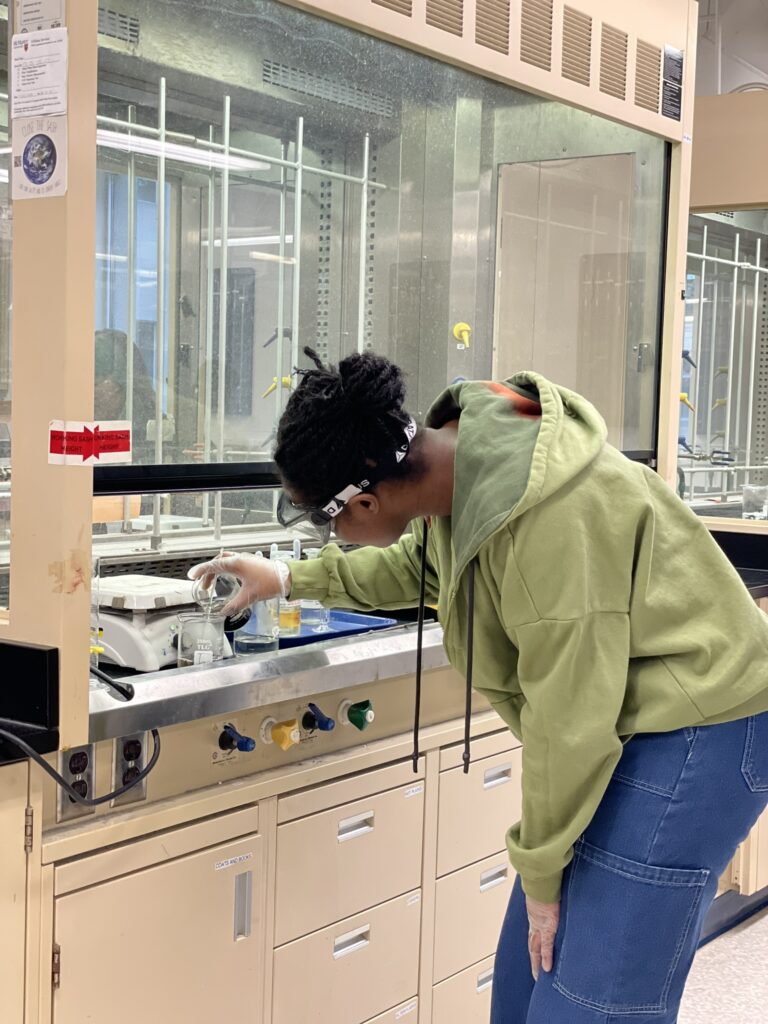
Students performing an experiment in the lab

Preparing for Your Visit:

Minimal preparation is required. Our team assumes students may need support at every step.

Students participating in ChemLab Days must be equipped with the following:

  • Fully completed Consent Form
  • Clothed from neck-to-wrists-to toes. Closed toed shoes and long pants are required. Lab goggles will be provided.
  • A calculator, and pen or pencil are required to fill out the worksheets for the Laboratory Experience and the Core Facilities Tours.
  • A brief review of light–matter interactions, or atomic structure may help, but is optional.
  • Pre-Lab Videos and Interactive Lessons (TBA) will be available on the Chemistry and Chemical Biology Visit to assist students in feeling comfortable with the lab.

Contact:

For waitlist inquiries, booking information, or additional details, please contact Tanja Petrovic (Academic Department Manager) at petrovt@mcmaster.ca